Deed Types in Mercer County Records
The Mercer County Clerk records every instrument that transfers land or touches a property's title trail. The document families in the Clerk's custody cover the main ground. A conveyance deed transfers an interest. A deed of trust or mortgage secures debt against the parcel. Releases, assignments, liens, plats, and easements each add a distinct layer to the record. The Clerk's online search menu may not label every one of these the same way, so search by instrument family rather than expecting an exact dropdown match. Mercer County deed records reward patience here. The family names matter more than the menu labels.
| Deed Type | What It Does | Common Use |
|---|---|---|
| Deed of conveyance | Records a transfer of an interest in real estate. | Sale, gift, or another transfer. |
| Deed of trust / mortgage | Records a real-estate security instrument. | Loan and later release or assignment trail. |
| Release / assignment | Updates or releases a prior recorded interest. | Follow a lender or lien change. |
| Tax-related deed or certificate | Connects a delinquent-land process with a recorded instrument. | Verify through Sheriff, Auditor, and Clerk. |
| Plat, easement, or right-of-way | Records a mapped lot or a right affecting land. | Clarify lot layout or use rights. |
A deed and a lien are different animals. The deed records a transfer. A lien or security instrument can affect an interest without ever changing the assessor's owner-of-record field. When you pull a parcel's surrounding title record, search the current party names along with lenders, trustees, contractors, or a municipality. Read the Mercer County deed records in date order. Pair them with the legal description rather than treating them as a bare list of names. Context is what makes the chain reliable.
Mercer County Grantor and Grantee Search
Grantor means the party conveying an interest. Grantee means the party receiving it. To walk a chain backward, find the latest transfer into the current owner of record. Then read the prior grantor's name. Search that grantor as a grantee in the earlier transaction. The Mercer County Clerk is the custodian. The county publishes no official public grantor-grantee search URL or earliest online year. The Assessor's property search is not a deed index. Treat it only as a stepping stone toward the recorded instruments themselves.
| Index Clue | What to Enter or Check | Research Status |
|---|---|---|
| Grantor / grantee name | Search the party name, role, surname, entity, and spelling variants. | Field-level interface not verified. |
| Instrument type | Deed, trust deed, release, assignment, lien, plat, easement, judgment. | Complete dropdown not located. |
| Recording date | Narrow around the known transfer or filing date. | Date-range field not verified. |
| Book / page or instrument number | Use the Assessor reference when one is shown. | County index format not verified. |
| Parcel / map | Carry the Mercer district, map, parcel, and suffix into a request. | Index cross-reference not verified. |
| Image or copy | Ask whether inspection or a certified copy is available. | Online images, fees, and cutoff not located. |
- Use the Assessor's parcel result to capture the Current Owner, legal description, and deed book/page reference.
- Ask the Clerk for the referenced deed and confirm its grantee, grantor, recording date, and written description.
- Use the grantor's name as a clue for the preceding conveyance, checking alternate spellings and entity forms.
- Compare acreage, lot, district, map, parcel, and reserved interests; stop and investigate if the description changes.
- Because the public online cutoff was not verified, ask the Clerk or State Archives where an older book is held.
- Grantor
- The party who conveys an interest in the instrument.
- Grantee
- The party who receives the interest.
- Chain of title
- The ordered set of recorded transfers used to trace title over time.
- Book and page
- A volume and page reference that helps a Clerk locate a filed document.
Request a Mercer County Deed Copy
The County Clerk's official page lists the office, its document functions, and request forms. The county offers no public deed image search online. There is also no grantor-grantee portal or posted copy fee schedule. Use a deed book/page reference when you have one. Otherwise, give the Clerk key details. Provide the property address, parcel number, current and former party names, an approximate date, and the instrument type. Ask whether the search can run at the counter, by mail, or through another office channel. Confirm the copy and certification charge before sending payment. Recording a document works differently. Recording requires an original, notarized document. The first page needs a 1½-inch top margin. It must also reach the counter before 4:00 p.m. The published local page accepts cash, money order, or check and no cards. Verify current rules with the Clerk. Its local fee examples conflict with the state statute, so confirm the amount before filing.
Recorded, not guaranteed. Mercer County deed records show instruments accepted into the public record; they do not establish that every interest has been found or that title is free of claims. A title search is a separate review.
A Bluefield Lien at the Mercer Clerk
City records can lead straight to a county filing. Bluefield's sidewalk-improvement program can end with a lien filed by the City Treasurer at the county courthouse. The project closes out after billing or repayment. For a property with that work history, ask Bluefield Engineering about the project file. Then search the Mercer County Clerk's land instruments for the lien and any release. Deed records hold more than sale deeds. Search names for the property owner, the city, a contractor, or any other party tied to the project. A lien is not a deed transfer. A city invoice does not prove a recorded lien was released. Check the recorded instrument and any later release. Ask the city and the Clerk when a document resists an address search. The Bluefield Engineering/Planning page describes the city side of this record trail.
Mercer County Recording Rules and Fees
Mercer County's published instructions require an original, notarized document for recording. A copy will not do. The first page needs a 1½-inch top margin. The office records nothing after 4:00 p.m. Payment runs to cash, money order, or check, with no card option stated. These rules govern presenting a document, not requesting a copy of one already recorded. The local fee examples are messy. The page lists $26 for a deed with no consideration and $26 plus $20 for a deed with consideration. Yet its own arithmetic shows $36. It also states a transfer fee of $5.50 per $1,000. W. Va. Code §59-1-10 sets a $30 statutory fee in the deed of conveyance/trust deed category. The published examples and the statute do not line up. Call the Mercer County Clerk before filing and ask for the current total.
Older Mercer County Land Descriptions
Mercer County dates to 1837, when it was carved from Tazewell County, Virginia. Deed records from that era carry Virginia-era wording. A metes and bounds description might start at a creek, follow a ridge, or call out a company tract, a coal camp, or a place name that no longer appears on any road sign. Connecting an old chain to a present-day E-911 address can therefore be difficult, even when the land stayed in one family or was later divided.
Work backward. Start with the most recent recorded conveyance. Compare the legal description at every earlier transfer. Follow each grantor back to the deed where he appeared as grantee. Check acreage, lot and block, district and map references, exceptions, mineral reservations, and easements at every step. When the land description changes, stop and investigate. Mercer County reports no courthouse fire and no destroyed deed-book range, so the early volumes survive.
Two historical collections can help. The Mercer County Historical Society offers an appointment-based library, and the WV Archives holds a Mercer County catalog covering old maps, newspapers, directories, and family files. Treat these as clues. The Clerk's recorded instrument remains the land-record source. A backward owner chain is described on the Mercer County former owners page.
Request Mercer County Deeds Offline
Do not assume a record is missing. Call the County Clerk instead. Give staff a parcel ID, district, map and parcel numbers, and any deed book and page reference. Add owner and former-party names, a date range, and the record type. Ask if staff can search by party or volume. Ask also whether inspection, a plain copy, or a certified copy is available, and confirm copy fees, archived retrieval time, and payment instructions directly.
West Virginia's Freedom of Information Act, W. Va. Code §29B-1-3, gives every person a right to inspect or copy public records, subject to exemptions. The custodian must respond as soon as practicable and within five non-holiday business days by providing copies, setting an inspection time, or denying the request in writing with reasons. Fees are limited to actual reproduction costs. Search and retrieval labor cannot be charged. Court files and protected records follow separate rules. Send those to the Circuit Clerk.
The Mercer County Clerk's official office page identifies the local custodian for recording and preserving official documents.
The Mercer Circuit Clerk records page explains the separate custody of circuit and family court records that may accompany a title dispute.
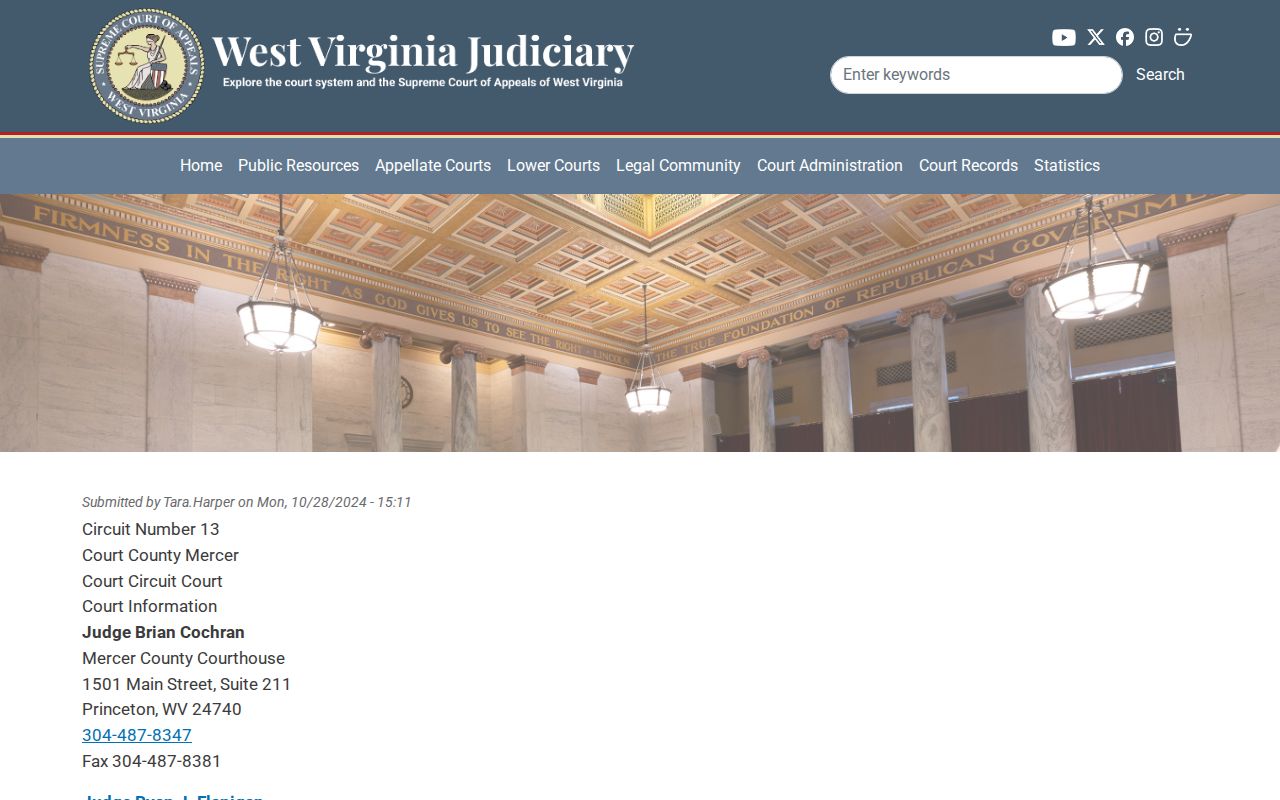
The West Virginia Judiciary's Mercer Circuit Court page gives the court context for case records tied to foreclosure, quiet title, or partition.
The West Virginia Magistrate Court case search is a separate lead when a judgment or proceeding may relate to a parcel; confirm docket details with the court before connecting it to title.